- Written on Modified on
- 7 min. reading time

You’ve committed to a microdosing protocol. You’ve weighed your truffles carefully, set your schedule, and waited for the subtle shifts in mood and focus everyone talks about. But after a few doses, you’re left wondering: am I doing something wrong? Why do I feel absolutely nothing?
You’re not alone. A significant number of people report minimal or zero effects from their initial microdosing attempts. The good news is that this usually isn’t a sign that microdosing won’t work for you at all. More often, it’s a signal that one or more variables need adjusting. Let’s walk through the most common culprits and what you can do about each one.
The dosage might be genuinely too low
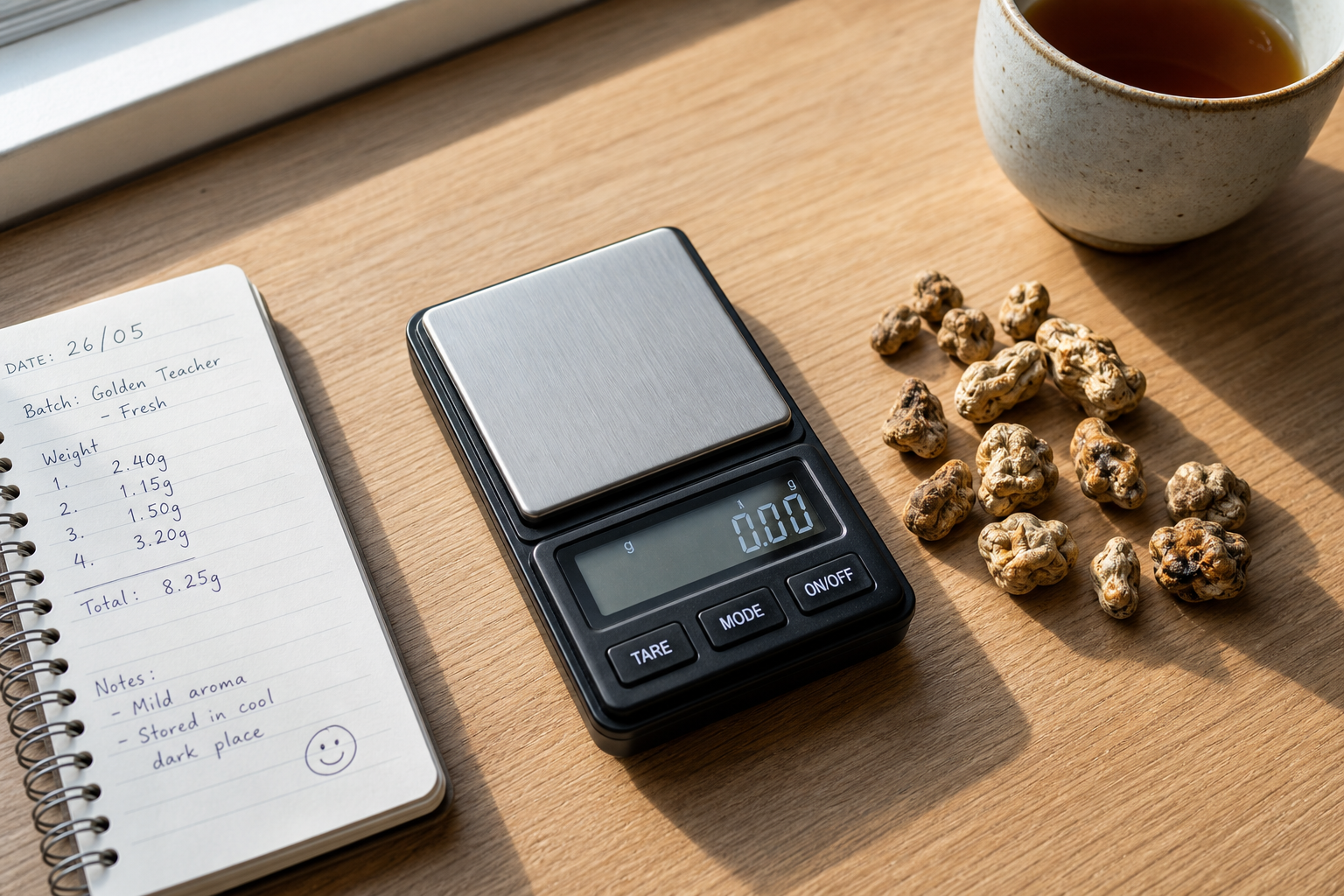
The most straightforward explanation is that your dose is simply below your perceptual threshold. While the standard microdose range for psilocybin truffles sits between 0.5g and 1g of fresh truffles, individual sensitivity varies considerably. Factors like body weight, metabolism, neurochemistry, and even gut health all influence how psilocybin is absorbed and processed.
If you’ve been starting at the lower end (say, 0.3g or 0.5g) and feeling nothing after several doses, it’s worth gradually increasing. Try adding 0.2g to your next dose and observe the effects over the following days. Our dosage calculator can help you find a starting point based on your weight and experience level, but remember that these are guidelines, not fixed rules.
The goal isn’t to feel high or impaired. You’re looking for subtle changes: slightly improved mood, easier access to flow states, reduced mental chatter, or enhanced pattern recognition. These effects can be so gentle that they’re easy to miss if you’re expecting something more dramatic.
Tolerance builds faster than you think
Psilocybin creates rapid tolerance at the serotonin 5-HT2A receptor, the primary site of its action. If you’ve taken a microdose two or more days in a row, or if you’ve recently taken a larger recreational dose, your receptors may be temporarily desensitized. This is why most protocols recommend gaps between doses.
The Fadiman protocol (one day on, two days off) and the Stamets stack (four days on, three days off) both build in recovery time to prevent tolerance. If you’ve been dosing daily or with insufficient breaks, your lack of effects might simply be pharmacological resistance. The solution here is patience: take at least four to five days completely off, then resume with proper spacing.
It’s also worth noting that if you’re on certain medications, particularly SSRIs or other serotonergic drugs, these can significantly blunt psilocybin’s effects. This isn’t about tolerance in the classic sense, but about receptor occupancy. Always consult a healthcare provider if you’re combining microdosing with psychiatric medications.
Batch potency varies more than you'd expect
Not all truffles are created equal. Even within the same strain and supplier, psilocybin content can fluctuate based on growing conditions, harvest timing, and storage. Fresh truffles stored improperly (too warm, too much air exposure) will degrade over time, losing potency week by week.
If you’re consistently taking what should be an adequate dose but feeling nothing, consider whether your batch might be weaker than average. This is particularly relevant if you’ve been using truffles that have been opened and stored for several weeks. Vacuum-sealed truffles kept refrigerated at 2-4°C maintain potency best, but once opened, degradation accelerates.
One practical test: if you’re comfortable doing so, try a slightly higher dose (say, 1.5g instead of 1g) on your next scheduled day and note whether you notice any perceptible shift. If that dose produces subtle effects where the lower one didn’t, you’ve likely identified a potency issue. For those just starting out, our starter’s deal includes fresh, properly stored truffles that give you a reliable baseline to work from.
Timing and stomach contents matter
When and how you take your microdose can significantly affect absorption. Taking truffles on a completely full stomach, especially after a heavy, fatty meal, can slow absorption and reduce peak effects. Some people report feeling almost nothing when dosing after breakfast, but noticeable (though still subtle) effects when taking the same dose on an empty stomach.
The conventional wisdom is to microdose in the morning, either 30 minutes before breakfast or with a light meal. This timing takes advantage of your body’s natural cortisol rhythm and ensures you can observe effects during your active day. But if you’ve been dosing right after a large meal, try shifting to an empty stomach or with just a piece of fruit.
Another timing consideration: some people are simply less perceptive to internal states in the morning, especially if they’re rushing through a routine. You might actually be experiencing subtle effects but not noticing them amid the chaos of getting ready for work. Try dosing on a day when you can move more slowly and pay attention to your internal experience.
You might be looking for the wrong signals
This one’s more subtle but surprisingly common. If you’re expecting a clear, unmistakable shift in consciousness, you might be overlooking the genuine but quiet effects that are actually happening. Microdosing is called sub-perceptual for a reason. The changes often show up as what doesn’t happen rather than what does.
Did you notice that you didn’t get as frustrated in traffic? That a creative problem felt slightly more approachable? That you smiled more during a conversation? These are legitimate microdosing effects, but they’re easy to dismiss or attribute to random variation if you’re waiting for something more obvious.
Keeping a simple journal can help. Note your mood, energy, focus, and social ease on a 1-10 scale before your dose day, on the dose day, and on the days after. Over time, patterns often emerge that aren’t obvious in the moment. You might discover you actually are feeling something, just not what you expected. Our complete microdosing guide includes journaling templates and tracking suggestions that can help you identify these subtle patterns.
Body weight and metabolism play a role
While body weight isn’t as decisive a factor as it is with some substances, it does matter, particularly at the extremes. A person weighing 50kg will generally require less psilocybin to feel effects than someone weighing 100kg, all else being equal. If you’re on the heavier side and starting with the standard 0.5g dose, you might genuinely need more to cross your threshold.
Metabolic differences also come into play. Some people are fast metabolizers of psilocybin, breaking it down quickly in the liver before it can exert full effects. Others metabolize it slowly, experiencing longer, more pronounced effects from the same dose. There’s no simple test for this; it’s something you discover through careful experimentation.
If you suspect metabolism is the issue, you might experiment with dose timing (empty stomach versus with food) or with slightly higher doses. Just increase gradually, by 0.1-0.2g at a time, and always give yourself at least three or four days between doses to assess properly.
What to try next
If you’ve been feeling nothing from your microdoses, here’s a practical troubleshooting sequence to work through:
First, verify your spacing. Take at least five full days off to reset any tolerance, then resume with proper gaps between doses.
Second, check your storage and batch freshness. If your truffles have been open for more than two weeks or stored improperly, consider starting a fresh batch.
Third, adjust your timing. Try dosing on an empty stomach in the morning, at least 20-30 minutes before eating.
Fourth, gradually increase your dose by small increments (0.2g at a time) while staying well below the threshold where you’d feel impaired or distinctly altered. Most people find their sweet spot between 0.7g and 1.2g of fresh truffles.
Finally, refine your observation skills. Start journaling consistently and look for patterns over weeks, not days. Microdosing benefits often accumulate subtly over time.
Remember, there’s no one-size-fits-all approach. What works for your friend or what you read in a forum might not match your biology. Microdosing is as much an art as a science, requiring patience, honest self-observation, and a willingness to experiment within safe boundaries. If you’ve systematically worked through these variables and still feel nothing, it’s possible that microdosing simply isn’t effective for you, and that’s okay too. Not every tool works for every person, and knowing what doesn’t work is valuable information in itself.