- Written on Modified on
- 6 min. reading time

You’ve bought the supplements. You know lion’s mane supports focus, cordyceps boosts energy, and a daily functional mushroom blend could genuinely benefit your morning routine. But the jar sits on your counter, unopened, or you take them sporadically for a week before forgetting entirely.
It’s not about willpower. It’s about format. The physical form of a supplement—capsule, powder, or gummy—directly influences whether it becomes a habit or another abandoned wellness product. And when it comes to building consistent routines, gummies have a distinct behavioral advantage that most people overlook.
Let’s look at why daily mushroom gummies work where capsules often fail, and how to design a ritual that actually sticks.
The friction problem with capsules

Behavioral scientists talk about “friction”—the small obstacles between you and an action. The more friction, the less likely you’ll do it consistently. Capsules seem simple, but they carry hidden friction points:
You need water. You need to swallow (which some people genuinely dislike). The jar lid might be stuck. The capsule might feel clinical, medical, like something you should do rather than something you want to do. Each tiny friction point creates decision fatigue, and decision fatigue is where habits go to die.
Gummies, by contrast, are friction-free. No water needed. No swallowing resistance. You can chew them anywhere—at your desk, in the kitchen, during your morning coffee. The act is pleasurable rather than obligatory. This matters more than most wellness advice acknowledges.
Reward loops and instant gratification
Habit formation relies heavily on reward. Not the long-term benefit you’re hoping for (better focus, sustained energy), but the immediate sensory reward that happens right now, in this moment.
A capsule offers no immediate reward. It’s neutral at best, unpleasant at worst. A gummy, on the other hand, provides instant positive feedback: a pleasant taste, a satisfying chew, a small moment of enjoyment. Your brain registers this as a reward, which strengthens the neural pathway associated with the behavior.
This is why children’s vitamins have always been gummies—not because kids can’t swallow pills, but because the format makes them want to take them. The same psychology applies to adults. We’re not that different when it comes to building automatic behaviors.
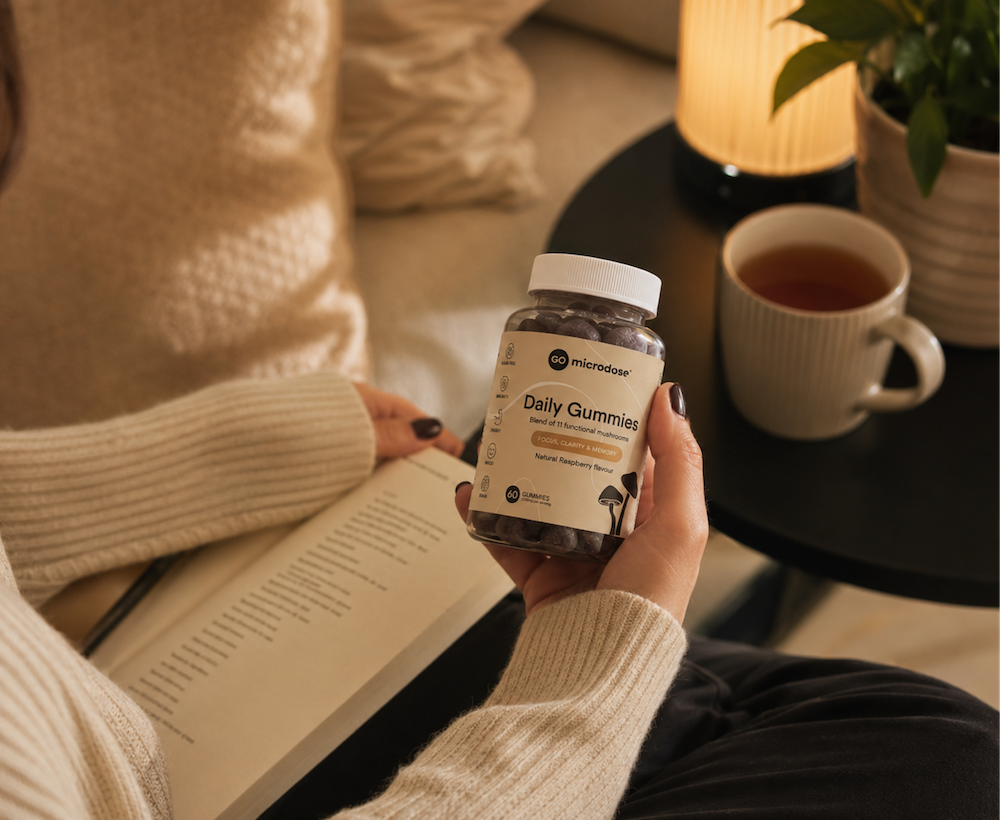
When you incorporate daily mushroom gummies into your routine, you’re not just getting lion’s mane or cordyceps—you’re creating a positive feedback loop that makes repetition easier.
Ritual versus task: the identity shift
There’s a meaningful difference between a task (“I should take my supplements”) and a ritual (“I start my day with my mushroom gummy and coffee”). Tasks feel like obligations. Rituals feel like identity.
Gummies lend themselves to ritual because they’re inherently more sensory and intentional. You can hold one, look at it, chew it slowly. It occupies a moment of your attention in a way that swallowing a capsule doesn’t. This small shift—from functional task to mindful moment—helps you think of yourself as someone who has a wellness practice, not someone who’s trying to remember to take pills.
James Clear, author of Atomic Habits, emphasizes that lasting habits come from identity change: “Every action you take is a vote for the type of person you wish to become.” A daily ritual with gummies feels like a vote for that identity. A forgotten bottle of capsules does not.
Anchoring your habit: the when and where
Format alone won’t build a habit. You also need an anchor—a consistent cue that triggers the behavior. The best anchors are existing routines you already do without thinking.
Try pairing your gummy with:
Morning coffee or tea: Place your gummies next to your kettle or coffee maker. As soon as you start brewing, you take one. The smell and ritual of your morning drink becomes the cue.
Breakfast: If you eat at the same time each day, keep gummies on the table or counter where you prepare food. First bite of breakfast = gummy first.
After brushing teeth: This works especially well because brushing is already automatic. Keep gummies in the bathroom cabinet (away from moisture, in their sealed container). Toothbrush down = gummy time.
The key is specificity. “I’ll take my gummy in the morning” is too vague. “I’ll take my gummy right after I pour my coffee, before I check my phone” is concrete enough to become automatic.
What the research says about format and adherence
Pharmaceutical research has long known that patient adherence varies dramatically by format. Studies on medication compliance consistently show that formulations perceived as easier or more pleasant to take have higher adherence rates.
A 2019 review in the Journal of Patient Preference and Adherence found that taste, texture, and ease of administration significantly influence whether people stick to a supplement regimen. Chewable formats scored higher for long-term use compared to capsules and tablets, particularly among people new to supplementation.
This isn’t about supplements “working better” in gummy form—the active ingredients are what matter for efficacy. It’s about whether you actually take them consistently, which is the only variable that truly determines whether you experience benefits.
An inconsistent capsule routine delivers no benefits. A consistent gummy routine delivers the full potential of the functional mushrooms you’re taking, whether that’s the focus-supporting compounds in lion’s mane or the adaptogenic properties of cordyceps and reishi.
Building your own ritual
If you’re ready to make daily functional mushrooms an actual habit rather than another aspiration, here’s a simple framework:
1. Choose your anchor. Pick an existing daily behavior that’s already automatic. The more specific, the better.
2. Place gummies in the anchor’s physical space. Next to the coffee maker, by the toothbrush, on the breakfast table. Visibility matters enormously.
3. Start with just one gummy per day. Don’t overcomplicate. The goal is consistency first, optimization later.
4. Track it minimally. A simple checkmark on a calendar or a tally in your phone creates a visual streak you won’t want to break.
5. Notice what you notice. After two weeks of consistency, pay attention to subtle shifts—steadier energy, clearer thinking, better stress response. These delayed rewards strengthen the habit once they become apparent.
You can explore our range of functional mushroom gummies designed specifically for this kind of daily ritual—formulated with lion’s mane, cordyceps, and other adaptogens to support focus and sustained energy throughout your day.
Format is not superficial
It’s easy to dismiss format as trivial—surely what matters is the ingredient, not the delivery? But human behavior doesn’t work that way. We’re not perfectly rational agents who consistently do what’s good for us. We’re creatures of habit, friction, and small sensory rewards.
The best supplement is the one you actually take. If gummies make that more likely—and the evidence suggests they do—then format becomes one of the most important variables in your wellness routine.
Start small. Anchor it clearly. Let the ritual build itself. Your brain will do the rest.